
Posted on Leave a comment

The Soul of the Grain: Why Beautiful Things Can’t Be Rushed

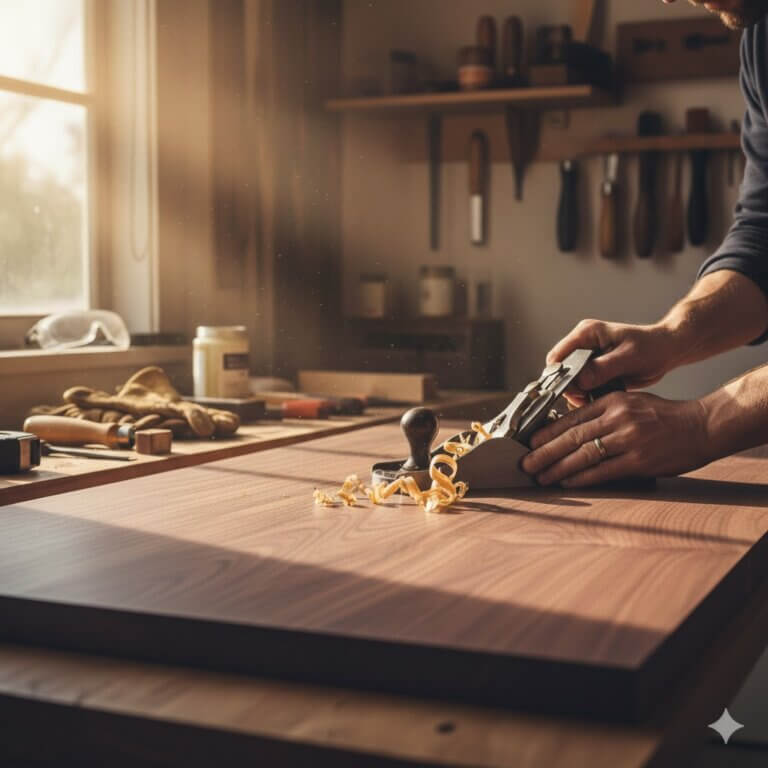
Close up of a woodworker hand planing a walnut table top for handcrafted furniture quality.

We live in an era of the “instant.” We have become a culture of next-day deliveries, fast fashion, and flat-pack furniture designed to be replaced rather than repaired. In this whirlwind of “right now,” the act of waiting for something feels almost counter-cultural.

But as a maker, I’ve learned a difficult truth: Beauty has its own clock, and it rarely aligns with a business spreadsheet.

The Internal Tug-of-War

As a business owner, I feel the pressure of timelines every single day. There are orders to fulfill, shipping windows to meet, and the logistical hum of Canterbury Woods Creations that demands efficiency. The “business owner” in me wants to check the box, print the label, and move to the next project.

But then, there is the wood. And more importantly, there is the work.

Knowing When to Step Away

There are moments in the shop when the schedule says “keep moving,” but the piece says “stop.”

Maybe I’m framing out a dresser, and the proportions just don’t feel right. Maybe the curve of a leg is technically correct, but it lacks the grace I envisioned. Or perhaps I’m looking at the drawer front of a writing desk, and the grain pattern isn’t “talking” to the rest of the piece the way it should.

In those moments, the most productive thing I can do is the hardest thing for a business owner: I step away. I’ve learned that you can’t force a solution when you’re staring too hard at the problem. I’ll leave the shop, grab a coffee, and let the piece sit overnight. I need to come back with “fresh eyes.” When I return the next morning, the wood usually tells me what it needs. Sometimes it means taking two steps back to take one giant leap forward in quality. That “wasted” time is actually where the soul of the furniture is born.

The Tension of the Hand-Planed Edge

When I’m standing at the bench with a hand plane, there is a specific moment of decision. I could use a power sander and be done in ten minutes. It would look “fine”. But when you take the time to plane the wood just right—feeling the blade shear through the fibers, hearing that crisp shhh of a perfect shaving—you aren’t just smoothing a surface. You are revealing the life of the tree.

That extra hour (or three) spent chasing a perfect finish—or the afternoon spent redesigning a frame because it didn’t “feel” right—doesn’t always make sense on a balance sheet. But it makes all the difference when that piece of furniture is finally sitting in your home.

Why We Struggle to Wait

Why is it so hard to wait for something worth having?

  • The Comparison Trap: We see mass-produced items available instantly and start to believe that “quality” and “speed” can coexist. In true craftsmanship, they rarely do.

  • The Disconnect: When we don’t see the maker’s process, we forget that a dining table or a serving board isn’t just a product—it’s a series of thousands of tiny, intentional choices.

  • The Fear of the Gap: We’ve lost the habit of living with an empty space while waiting for the right piece to fill it.

An Invitation to Slow Down

When you commission a piece of custom furniture, you aren’t just buying a utility; you are choosing to participate in a slower way of living. You are saying that the way a joint fits together matters more than the date on a shipping label.

Choosing beauty over a timeline is a struggle, both for me as the builder and for you as the owner. But when that piece finally arrives—with its hand-planed glow and its solid, generational weight—the wait usually vanishes the moment you touch the wood.