
When you step into a mass-market furniture store, the pieces often look beautiful on the surface. But the true test of a piece of furniture isn’t how it looks in a showroom; it’s how it performs after five years of daily use.
At Canterbury Woods Creations, we believe the soul of a piece is found in its joinery—specifically, the drawers. In this guide, we’ll explore why the dovetail joint remains the undisputed king of drawer assembly and the nuances between machine-precision and hand-cut artistry. When you invest in custom dovetail drawers, you aren’t paying for the wood you see on the outside.
The Foundation: Dovetails vs. Modern Alternatives
Drawer boxes are the hardest-working part of any cabinet or desk. Every time you pull a handle, you are applying physical stress to the front of the drawer, trying to pull it away from the sides. Most furniture fails here first.
1. Butt Joints and Staples
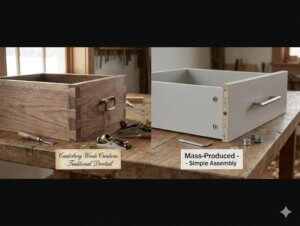
In “disposable” furniture, you’ll often find butt joints. The two boards simply meet at a 90-degree angle and are held together by glue and staples or small finish nails.
-
The Flaw: There is no structural integrity. Once the glue dries out or the wood expands and contracts with the seasons, the staples pull through the grain, and the drawer face eventually ends up in your hand.
2. Pocket Hole Joinery
Pocket screws are popular in DIY circles. A hole is drilled at an angle into one board, and a screw pulls it into the second.
-
The Flaw: While much stronger than a staple, it relies on a metal fastener. Over time, the constant vibration of opening and closing can “wallout” the screw hole in the wood, leading to a wobbly drawer that is difficult to repair.
3. The Dovetail: The Mechanical Advantage
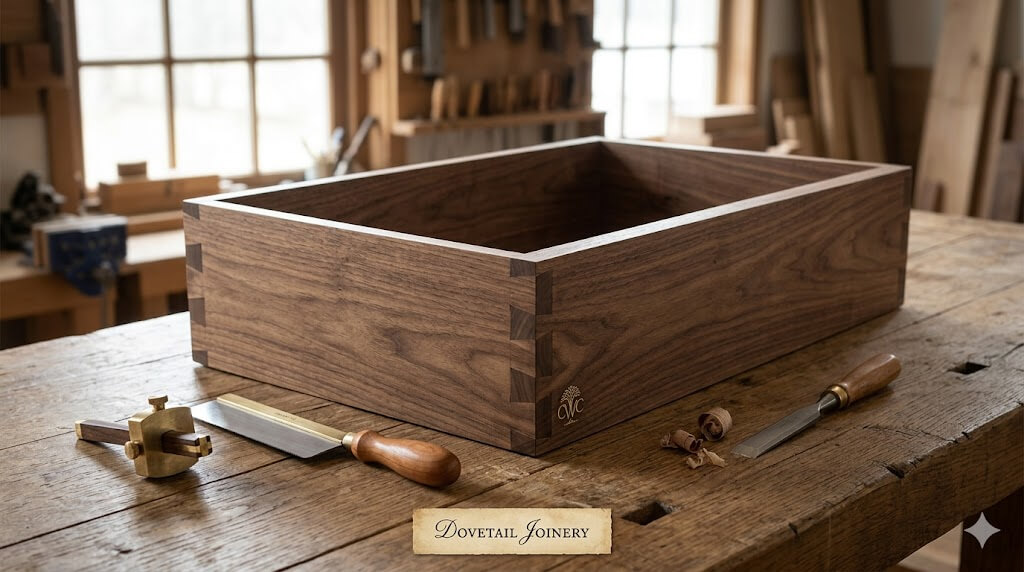
A dovetail joint consists of “tails” and “pins” that interlock like a puzzle. Because of the trapezoidal shape, the joint can only be pulled apart in one direction.
The Result: When we build a drawer with dovetails, the physical shape of the wood prevents the drawer front from pulling off. It is a “mechanical lock” that doesn’t just rely on glue; it relies on physics.
The Precision of the Jig: Machine-Cut Dovetails
For many of our custom projects, we utilize a high-quality dovetail jig and a router. This is the standard for premium custom cabinetry today.
The Benefits of Jig-Cut Joints:
-
Uniformity and Strength: Because the jig uses a fixed template, every tail and pin is identical. This ensures a tight, seamless fit with maximum glue surface area, creating a rock-solid drawer box.
-
Efficiency for the Client: Hand-cutting a dozen drawers for a kitchen or a large dresser can add forty hours of labor to a project. Using a jig allows us to offer the legendary strength of a dovetail without the extreme labor costs associated with manual sawing.
-
Clean Aesthetics: Jig-cut dovetails offer a very “clean” and modern look. They signal to anyone who opens the drawer that this piece was built in a professional shop with high-quality standards.
The Art of the Saw: Hand-Cut Dovetails
If machine dovetails are a feat of engineering, hand-cut dovetails are a feat of artistry. This process involves marking each joint with a knife, cutting the angles with a fine-toothed hand saw, and “chopping” out the waste wood with a razor-sharp chisel.
Why Choose Hand-Cut?
-
The “Skinny” Pin: In machine joinery, the “pins” (the thin parts of the joint) must be at least as wide as the router bit. In hand-cutting, we can make pins that are incredibly thin—sometimes called “London style.” This is a look that a machine simply cannot replicate.
-
Variable Spacing: A jig forces a specific pattern. By hand, we can vary the size and spacing of the dovetails to perfectly match the height of your specific drawer, creating a balanced, bespoke look.
-
A Connection to Tradition: When you see the tiny marks left by a marking gauge or the slight variations in a hand-cut joint, you are seeing the “fingerprints” of the maker. It connects your piece to centuries of woodworking history.
Which Should You Choose?
-
Choose Jig-Cut if you want the best possible strength and a clean, professional look for high-use items like kitchen cabinets or daily-use dressers.
-
Choose Hand-Cut for a “legacy” piece—an heirloom dining table, a jewelry box, or a custom desk where the joinery is meant to be a focal point of the design.
At Canterbury Woods Creations, we take pride in the “honesty” of our work. Whether it’s the hidden underside of a table or the joinery inside a drawer, we build things to be used, loved, and passed down.
Every home deserves a piece that tells a story. If you’re ready to upgrade your space with furniture built to last a lifetime, let’s talk about your vision.